

Watch the video above, or read the full version below. The article has the charts and sources the video didn’t have room for.
A Chinese team used ChatGPT to write posts turning Americans against AI data centers.
Then they used it to write reports on how to keep from getting caught.
That’s how OpenAI caught them.
In the first half of 2026, almost $200 billion of American data centers got blocked or delayed.
Washington blames China.
But at least 59 of those fake accounts never got a single like.
And when the company I’m helping build lost a city council vote this year, China wasn’t in the room.
So who is to blame?
TLDR
The China-linked campaign was real, and it reached almost nobody. More Americans read about the plot than were ever touched by it.
The power bill complaint holds in one big region (PJM) and fails in most others, including Iowa.
The real brake is the town meeting. 71% of Americans oppose a data center in their area. That’s more than oppose a nuclear plant.
When a town says no, the demand moves to approved sites and self-supplied power. Both need the same equipment, and the line for it runs years long.
That equipment line is where some of my own money sits.
The fake accounts
Start with what was found.
In June, OpenAI published a report on a group of accounts it had banned.
The people behind them typed in Chinese and posted as Americans.
They asked ChatGPT for short comments in English and for comic strips, all making one argument: data centers are driving up the price of electricity for regular families.
OpenAI’s read is that this was a social media team at a private company that works for the Chinese government. (OpenAI, June 10, 2026)
Two months later, on August 27, X said it had found a network of fake accounts it suspects were run out of China.
About 200 of them were posting about data centers and power bills, inside a network of about 200,000. (X Global Government Affairs)
I said in my four forces video that this smelled like sabotage.
I still think that was the intent.
Then I read the whole record.
A Clemson researcher pulled the accounts X suspended.
He found about 90 posts.
At least 59 of the accounts never got a single like or reply. (The Next Web)
OpenAI said the same thing in its own report: the campaign never spread past the accounts that posted it.
Meanwhile, X’s announcement about the campaign got more than 3 million views.
More Americans heard about the plot than were ever reached by it.
None of this is new, by the way.
In 2022, a security firm Google now owns found a pro-China network posing as worried Texans, trying to stir up protest against a rare earths plant. (Mandiant via Google Cloud)
The play is simple. Find a fear that already lives in a town, and pour gasoline on it.
There’s a money trail too.
Two House committee chairmen asked the Treasury and the IRS to investigate the nonprofits behind some of these campaigns. (Ways and Means letter, Sept 22, 2026)
So far, the money that’s been traced belongs to an American businessman living in Shanghai.
Nothing on the public record ties it to the Chinese government.
If you’re positioning around the idea that China is what’s stopping these projects, you’re fitting your money to the wrong story.
The scale of the stall
Here is the number everyone is quoting.
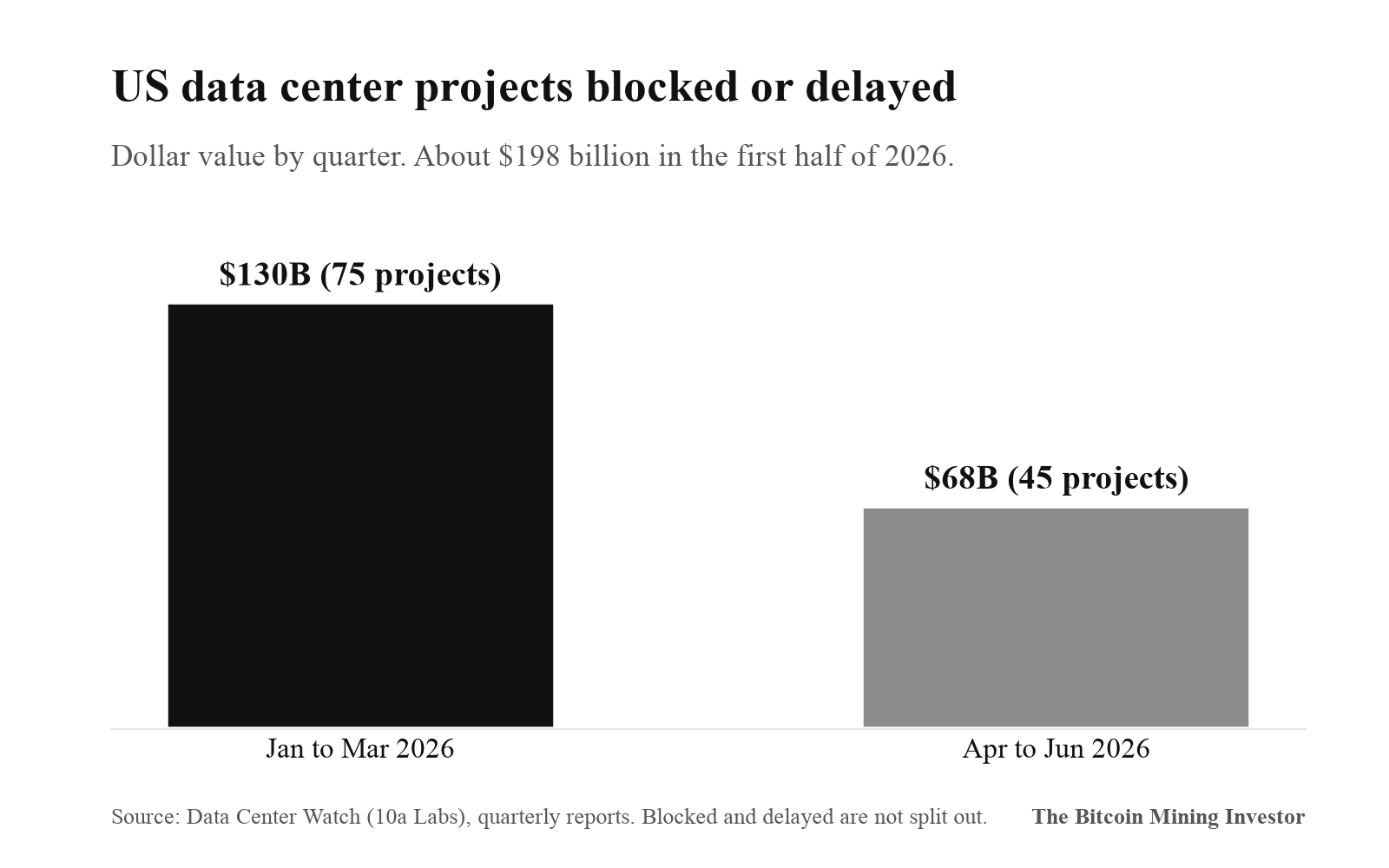
Data Center Watch counted about $130 billion of projects blocked or delayed from January to March, and about $68 billion from April to June. (Q1, Q2)
Two things worth knowing about that count.
It mixes blocked with delayed, and no public split exists.
And the second quarter came in at about half the first.
A different tracker, Heatmap Pro (Oct 6, 2026), counts at least $260 billion of data center investment canceled in 2026 through September 30, with about $130 billion of it in the third quarter alone.
It measures something different (cancellations, not delays), so don’t add the two together.
Either way, the direction is clear. A lot of money that wants to build is sitting still.
The power bill
The fake accounts were pushing one claim, and a lot of real people believe it.
Do data centers raise what you pay for electricity?
Prices really are rising.
The average US home paid 18.31 cents per kWh in July 2026, up 4.9% from a year earlier. (EIA)
So people aren’t imagining it. The question is what’s causing it.
Start with Iowa.
Microsoft, Google and Meta all run data center campuses there, and we run Bitcoin mining facilities there.
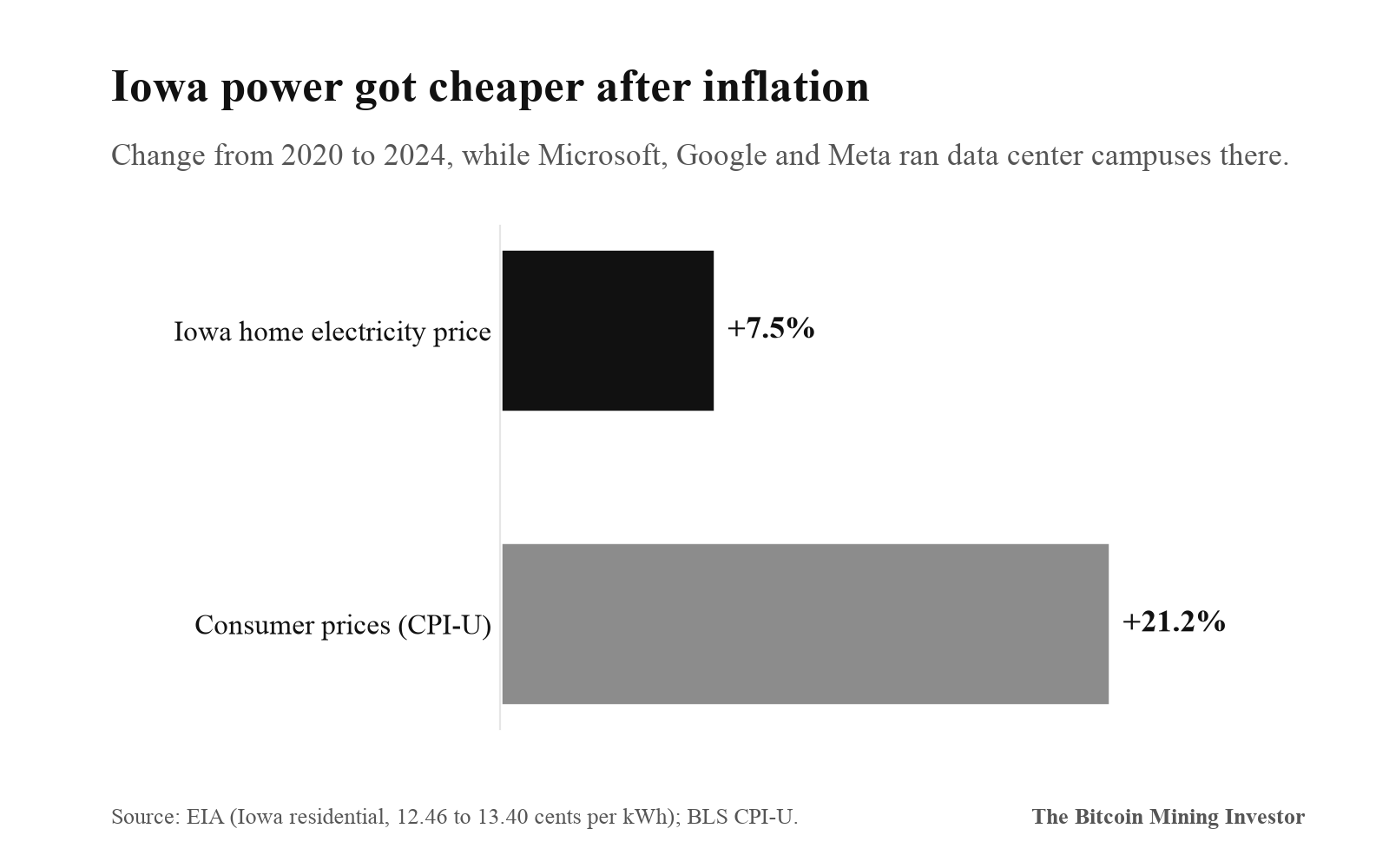
From 2020 to 2024, the price an Iowa household pays for power went up 7.5%.
Inflation over the same stretch was 21.2%.
So after inflation, power in Iowa got about 10% cheaper while all of that was getting built.
Here’s the reason it makes sense.
A power grid is mostly fixed cost. The poles, wires and substations cost the same whether they’re busy or idle.
When a big customer shows up and buys power around the clock, that fixed cost gets split across a lot more electricity.
Think of a restaurant’s rent. The more tables it fills, the less rent hides in the price of your meal.
A national lab checked this across every state.
From 2019 to 2024, the states where demand for power grew the most saw prices fall after inflation. The states where demand shrank saw prices rise. (Berkeley Lab and Brattle)
Nobody has ever stood up at a council meeting to complain that their bill went up slower than inflation.
But there is one region where the claim holds, and it’s a big one.
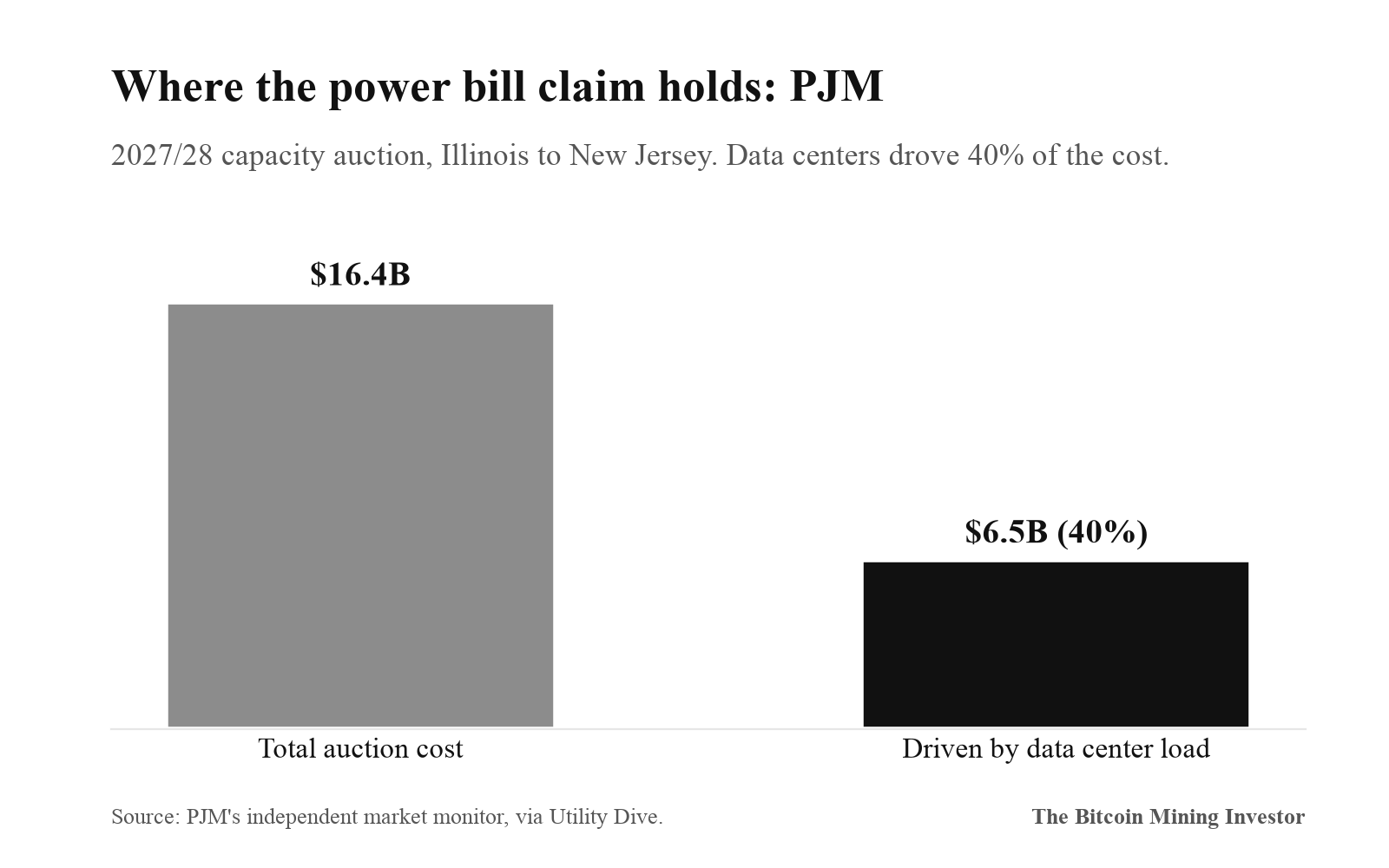
PJM runs the grid from Illinois to New Jersey, including Northern Virginia, the largest data center market on Earth.
It holds an auction to make sure there’s enough power for the hottest day of the year.
Data centers showed up faster than new power plants could get built.
PJM’s own market monitor attributes $6.5 billion, or 40%, of the $16.4 billion cost of the 2027/28 auction to data center load, most of it for data centers that aren’t built yet. (Utility Dive)
Here’s a detail I like. The fake accounts didn’t invent their material. They linked to real local news about that same PJM auction.
So if you live in Ohio or Maryland and someone tells you a data center raised your bill, they have a point.
The same technology that lowered bills in Iowa raised them in PJM.
The difference is who pays when a big new customer plugs in, the customer or the neighbors.
And those rules are changing.
In July 2025, Ohio regulators approved a rule for the utility around Columbus. New data centers there pay for at least 85% of the power they reserve, for up to 12 years, whether they use it or not. (POWER)
My test for any data center project your money is tied to: who pays for the power it needs? If the answer is the neighbors, expect a fight.
The town meeting
So the plot reached almost nobody, and the power bill claim depends on where you live.
Why did $198 billion of projects get stopped anyway?
This is the one I lived through.
In America, whether a data center gets built comes down to a handful of local officials in a room full of their own voters.
In 2026, the company I’m helping build asked a city in Iowa to change its zoning so we could expand.
I watched the meeting on the live stream.
People got up and said Bitcoin miners were going to give them cancer.
People talked about noise. We had measured it, and it’s no louder than an industrial cooler.
People talked about water. Our cooling runs the same liquid around a closed loop, and we told the city most of the water use would come from the bathrooms and the sprinkler system.
On Facebook, people passed around pictures of our facility destroying the park.
The pictures were made with AI.
You can’t make that up.
The project was declined.
I want to be fair to the people in that room.
Nobody paid them, and they weren’t bots. They were neighbors who were scared, and they had no reason to take our numbers on faith.
We came with good information, and it didn’t matter, because to that room we were strangers.
What I took from it is that this comes down to relationships. If a town doesn’t know you before you ask it for something, the facts never get a hearing.
And it isn’t only us.
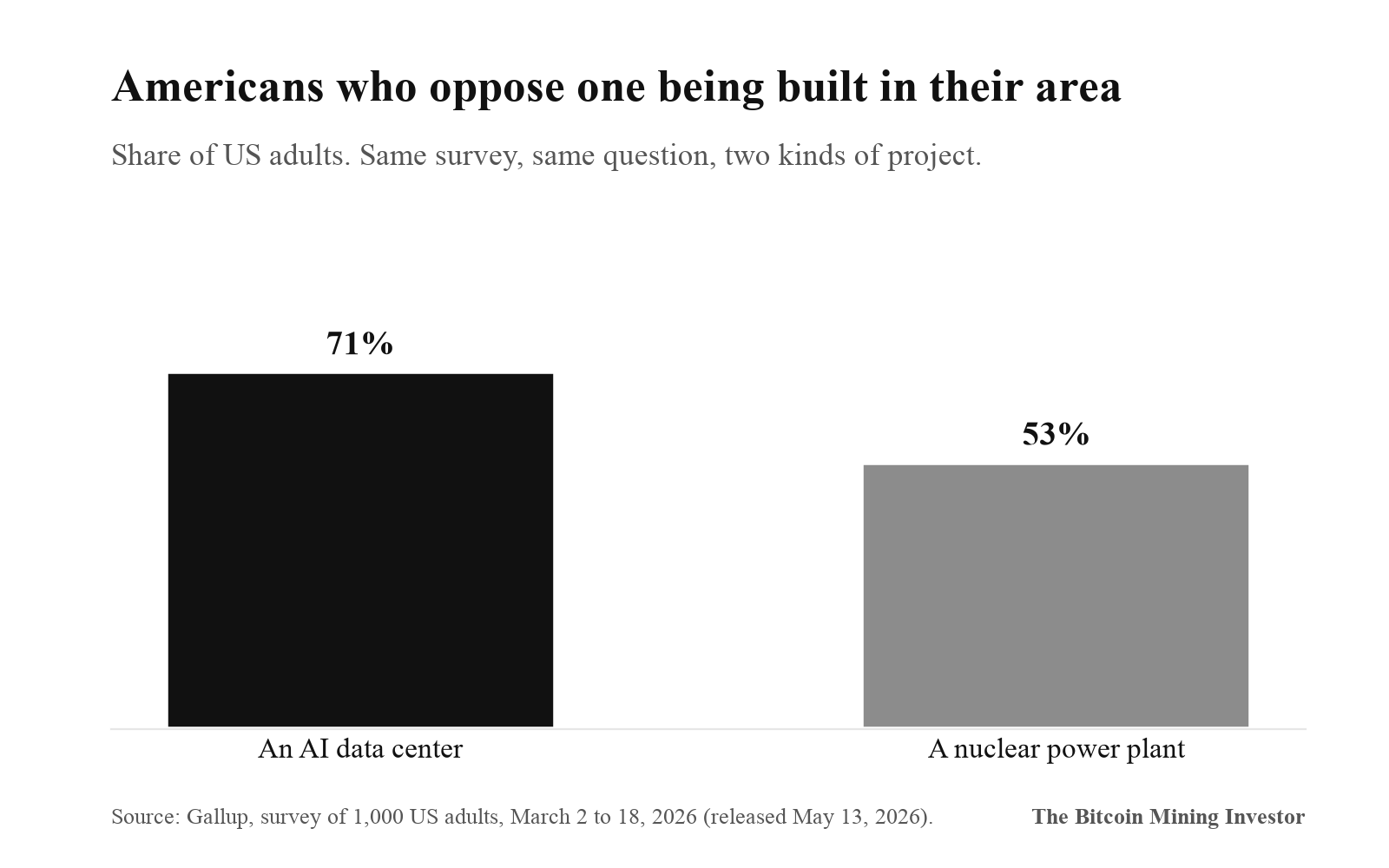
71% of Americans now say they’d oppose an AI data center in their area. 53% say the same about a nuclear plant. (Gallup, May 13, 2026)
Elsewhere in Iowa, over the summer, a county board voted to stop taking new data center applications for 18 months.
Underneath the noise and the power bill sits a bigger fear. A lot of people believe a data center is training the thing that’s coming for their job.
That’s a fair thing to be afraid of.
Every big technology looked like that at the start. Cars put the horse trade out of business, and almost everybody ended up better off.
But somebody has to show up and make that case, and mostly nobody does.
Now look at the other side.
China runs a national program that decides where its data centers go. There’s no town meeting to lose.
In Stanford's AI Index, 83% of people in China said AI products and services do more good than harm. In America it was 39%. (Stanford HAI)
So if this is a war, the 200 fake accounts are the least of it.
Where the money goes
The fake accounts, the power bill and the town meeting.
If fake accounts were what’s stopping these projects, the problem ended the day X suspended them.
You can’t suspend a town meeting.
So this shortage lasts, and a shortage that lasts has a price.
The customers haven’t gone anywhere. Amazon told shareholders it won’t have enough capacity to meet demand in 2026, and expects the same in 2027. (Amazon Q2 2026 call)
So when a town says no, the company doesn’t go home. It loses time, and it goes looking for power it’s allowed to use.
There are 2 places to find it.
1. A site that’s already approved.
Every pause a county votes on makes those sites scarcer, because a pause only stops the next project.
Watch what Google did.
In September 2025 it pulled a $1 billion rezoning request in Indianapolis minutes before the council voted.
It already had approved land one county over, from that February.
Two weeks later that county approved more, and by November Google was moving dirt. (WRTV)
It could walk away from one council because it already had approval from another.
Washington sees it too. The last 2 presidents each signed an order to open federal land to data centers, where a town meeting doesn’t decide.
2. Power the company brings with it.
In March 2026, 7 of the biggest names in AI pledged at the White House to build, bring or buy the power their new data centers need. (White House)
A power plant needs a permit too, so that doesn’t get them past the council either.
Now look at what both paths need.
An approved site still needs a substation, the yard of transformers that ties it to the grid.
A company bringing its own power needs a gas turbine.
That’s the line everybody is standing in.
GE Vernova, one of the biggest gas turbine makers in the world, had 116 GW of orders and reservations by mid-2026, and it is taking reservations into 2031. (Utility Dive)
The wait for a large generator transformer passed 160 weeks in early 2026. That’s more than 3 years. (Wood Mackenzie via Reuters)
My own industry shows the same gap.
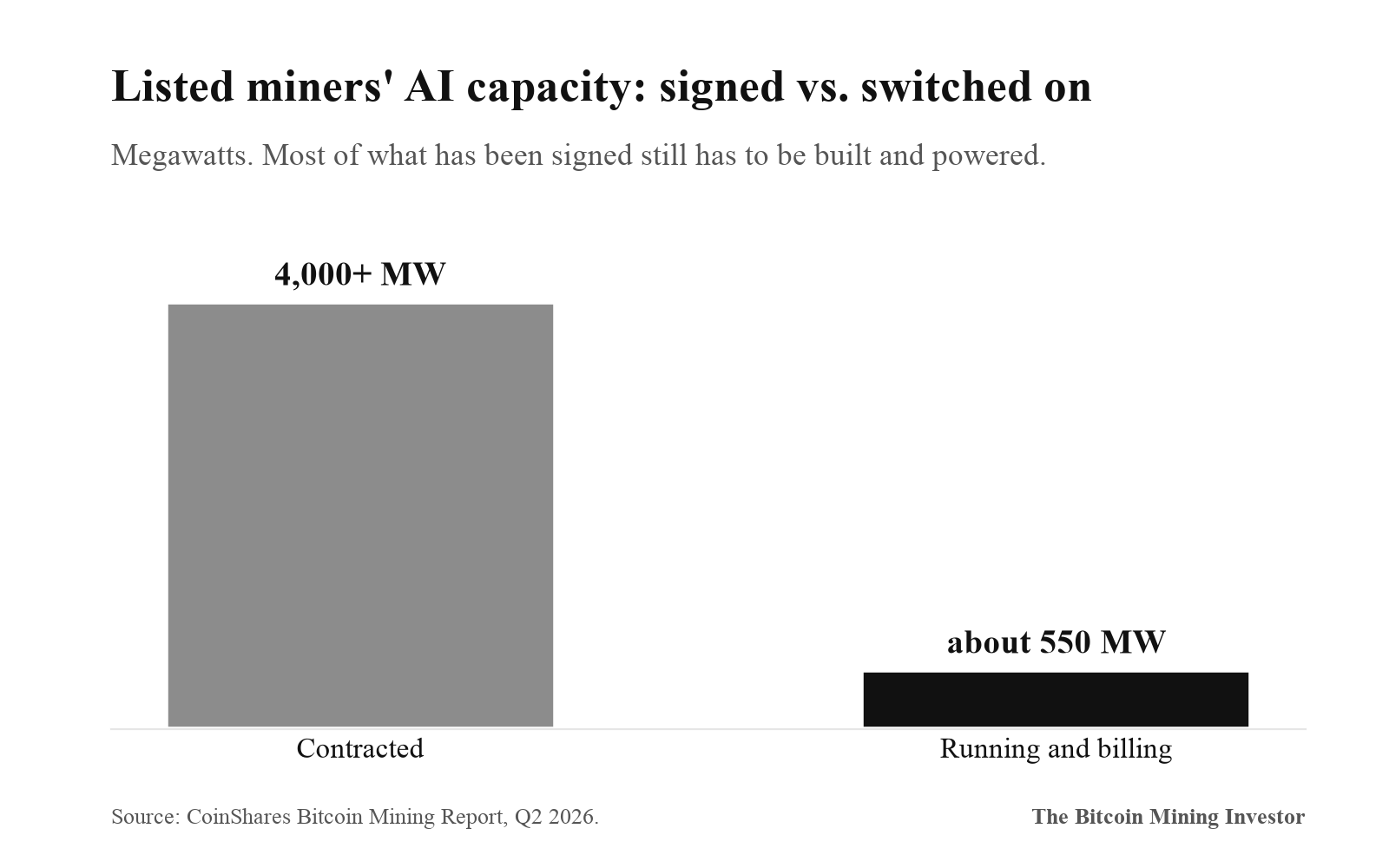
Public Bitcoin miners have signed contracts for more than 4,000 MW of AI capacity. About 550 MW of it is running and getting paid. (CoinShares Bitcoin Mining Report, Q2 2026)
The rest is waiting to be built and switched on.
How I’m positioned
Some of my own money is in energy infrastructure, the companies working to solve this bottleneck.
I don’t have to guess which town says yes or what China does next.
Whoever gets approved has to buy this equipment first.
It isn’t a secret anymore. Some of these stocks have already run a long way, so the price you pay matters.
It’s also the part I went to work in. The company I’m helping build goes after sites where the power is already secured.
What would change my mind: the wait for transformers and turbines getting shorter. If a transformer takes 1 year instead of 3, the shortage is ending.
Run it on your own portfolio
I’m not going to name stocks, because the winners change.
What I’ll give you is the map I built for this, the Allocator’s Map.
You hand it to your own AI, tell it what you own, and it sorts every position into power, compute or money. It also tells you when a trade is already crowded.
Get the Allocator’s Map (free)
Run it this week and look at one number: how much of what you own is in power.
The fake accounts, the power bill and the town meeting all point the same way. This buildout gets decided one city council meeting at a time.
Next time a town says no, you’ll know where the money goes.
Should be another interesting week in markets.
Where the energy flows, the money follows.
Disclosure: I work at Simple Mining, a Bitcoin mining hosting company. Nothing here is financial or tax advice.