

Correction, September 2026. The original case study below counted the miner’s power bill twice. It gave Bob the coins his daily DCA bought, then also subtracted those same coins from Jane’s mined Bitcoin, even though Jane had spent those dollars on power. That made mining look worse than it was. The numbers below are corrected, and mining comes out ahead at both two and four years. I reran it with daily data at 7¢ power: selling the machine after two years ended with 75% more Bitcoin than holding, and after four years 25% more.
Exciting couple of days ahead.
Hard not to feel bullish.
Here is where our booth will be in the Mining Village:

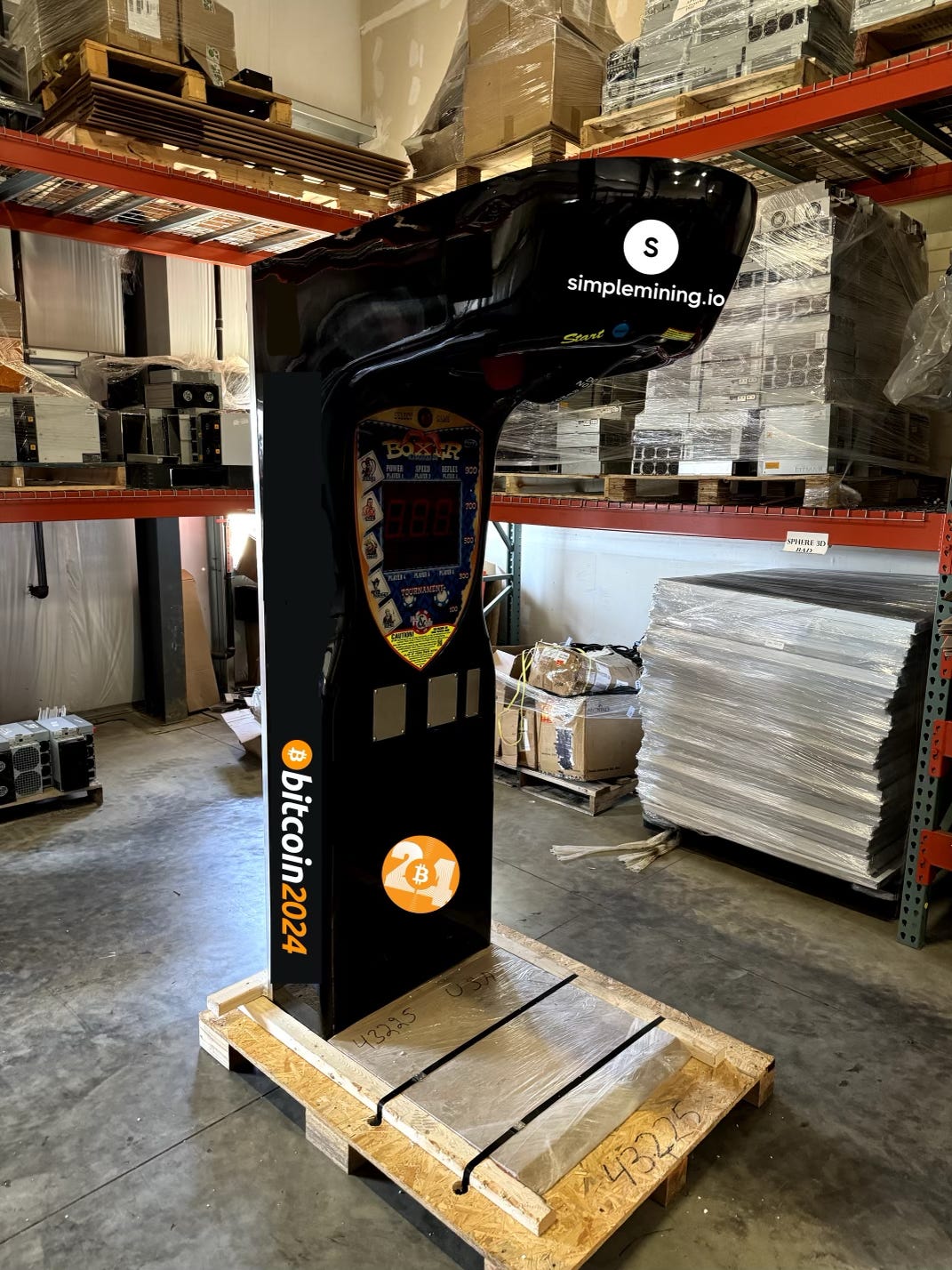
Be sure to stop by and punch this thing to win an ASIC:
Mine or Buy BTC?
This report looks at the tradeoffs of buying spot Bitcoin vs purchasing a miner.
It is generally cheaper to mine Bitcoin than to purchase it at the going exchange rate. Miners spend between $20k and $40k on electricity to mine 1 BTC.
This is contingent on several factors like machine efficiency and power rate.
This does NOT mean this is the most PROFITABLE strategy. Mining at scale requires a large hashrate and infrastructure.
For many individual Bitcoin investors, it makes the most sense to purchase Spot BTC.
This is where Simple Mining comes in.
The goal of Simple Mining is to bridge this gap and allow the average Bitcoin investor to gain exposure to a PROFITABLE mining position.
Because at the end of the day, you want to choose the strategy that stacks the most sats.
This report will analyze historical numbers to get a base case and get an idea for future scenarios.
Has it been profitable to mine Bitcoin in the last 4-year cycle?
Yes, for the most part, but as with most things like this, many variables are in play.
We will first look at the time period of 7/24/20 to 7/24/24; both dates are ~ 70 to 90 days after a halving(decreased block subsidy).
This is also the most recent cycle where we can assess the 4-year life of a new-gen miner.

This hypothetical case study will use Bitcoin investors Bob and Jane.
They are both looking to deploy capital with the goal of stacking as much BTC as possible.
They each decide to make a lump sum allocation and then a dollar-cost average for the period above.
Bob: Spot Buy with DCA
A lump sum purchase on 7/24/20 of $2,500 (cost of new-gen miner).
The lump sum spot buy would gain ~.26 BTC based on the BTC price on 7/24/2020
Start a daily DCA of $6 (daily cost of running S19).
We will fix exchange fees at 1%, although this will have a minimal impact over this time period.
From 7/24/20 to 7/24/24, this would result in ~ 0.30 BTC accumulated using a DCA calculator.
The total BTC stacked from this strategy is = 0.56 BTC (lump sum + DCA)
Jane: Purchase BTC Miner
A lump sum purchase of an S19 on 7/22/20(top tier ASIC at the time) for ~ $2500
Machine operation specs are 95 Th/s, 34.2 W/Th, $0.08/kWh.
We will fix pool fees at 0.07%, which is the rate our partner Luxor Pool has.
This machine would mine a total of 0.62 BTC from 7/24/20 to 7/24/24.
The machine costs roughly $6/day in electricity, resulting in $8760 over 4 years.
Bob put those same $6 a day into his DCA, so the power bill is already counted on his side of the ledger.
Finally, the BTC gained from the sale of the S19 on 7/24/24 would be ~ $670 or ~ 0.01 BTC.
The total BTC stacked from this strategy is 0.62 + 0.01 = 0.63 BTC (corrected)
Mining comes out 0.07 BTC ahead of buying.
But this is assuming a 4-year use of the S19.
If we rerun this with a 2-year term, things look much different.
Bob: Spot Buy with DCA
A lump sum purchase on 7/22/20 of $2,500
Acquisition of ~.26 BTC based on BTC price on 7/22/2020
Start a daily DCA of $6 (daily cost of running S19).
DCA from 7/24/20 to 7/24/22 would result in 0.15 BTC accumulated.
The total BTC stacked from this strategy is = 0.41 BTC (lump sum + DCA)
Jane: Purchase BTC Miner
A lump sum purchase of an S19 on 7/24/20 (top tier ASIC) for $2500.
Machine operation specs are the same as before: 95 Th/s, 34.2 W/Th, $0.08/kWh.
This machine would mine a total of 0.44 BTC from 7/24/20 to 7/24/22.
Her $6 a day of power is the same money Bob put into his DCA, so nothing more comes off her total.
Finally, the BTC gained from selling the S19 on 7/22/22 would be ~ 0.18 BTC.
The total BTC stacked from this strategy is 0.44 + 0.18 = 0.62 BTC (corrected)
The miner strategy stacks 0.21 BTC more than DCA in this case (corrected).
This example also does not include potential tax depreciation in the miner strategy.
If Jane’s yearly income is $100k, then according to current bonus depreciation rules, she could depreciate 60% of asset value in the first year and reduce her taxable income:
$100k(yearly income) - $1500(60% of miner purchase price) = $98.5k taxable income.
This analysis shows the importance of the entry point for the miner.
Good rule of thumb:
New generation machines purchased at local bottoms(miner capitulation) appreciate in value during pumps in the exchange rate, and mined profits remain fixed because hashrate lags behind(it takes longer to plug in miners than for the price to rise).

There is a positive correlation between the price of mining computers and the price of Bitcoin.

This is just a chip off the block when evaluating ASIC profitability.
Taxes, credit, and privacy also impact which route is the best.
In summary,
Mining CAN be more profitable than DCA
Having a solid cycle entry point MATTERS
ASIC prices rise with the price of Bitcoin
Simple Mining helps make this process SIMPLE
If you are interested in getting a new-gen miner (we just received stock of S21 Pros - 234 Th/s, 15 W/Th) reach out to Nick - nick@simplemining.io