

Bitcoin sentiment has been in extreme fear territory for weeks.

The last time the index reached a score of 5 was August 2019, when Bitcoin was $10,000.
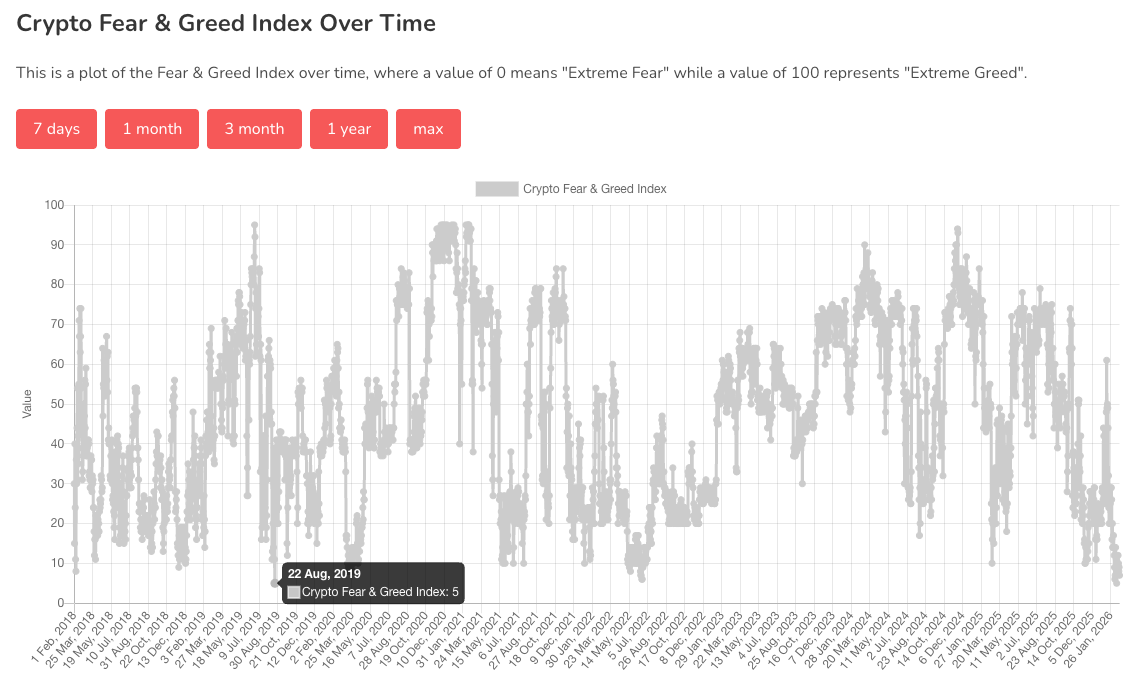
Investing wisdom says this is opportunity:
Warren Buffett (Berkshire Hathaway, 1986): “We simply attempt to be fearful when others are greedy and to be greedy only when others are fearful.”
Sir John Templeton: “Bull markets are born on pessimism, grow on skepticism, mature on optimism and die on euphoria.”
Contrarian proverb: “Buy when there’s blood in the streets, even if the blood is your own.”
Benjamin Graham: “In the short run, the market is a voting machine. In the long run, it is a weighing machine.”
Warren Buffett: “The market is a device for transferring money from the impatient to the patient.”
J.P. Morgan: “In bear markets, assets return to their rightful owners.”
Peter Lynch: “Far more money has been lost by investors trying to anticipate corrections, than lost in the corrections themselves.”
Howard Marks: “The price can be lower than it should be only when most people don’t see its merit.”
It’s easy to buy Bitcoin when everyone thinks it’s going to $1M tomorrow. When your family and friends think you’re genius.
But the reality is, Bitcoin is only 17 years old. Gold is 3000 years old, and they compete for the same pool of liquidity.
So you might be early. And you have to be ok with that. Because being early is often indistinguishable from being wrong to everyone else.
“The growth of the Internet will slow drastically, as the flaw in ‘Metcalfe’s law’—which states that the number of potential connections in a network is proportional to the square of the number of participants—becomes apparent: most people have nothing to say to each other! By 2005 or so, it will become clear that the Internet’s impact on the economy has been no greater than the fax machine’s.”
Paul Krugman, winner of the Nobel Prize in Economics, 1998
If you're anything like me, you lie awake at night thinking about how Bitcoin scales from here.
Every Bitcoin investor knows the halving schedule.
Every four years, the block subsidy gets cut in half. It happened in 2024 and it’ll happen again in 2028.
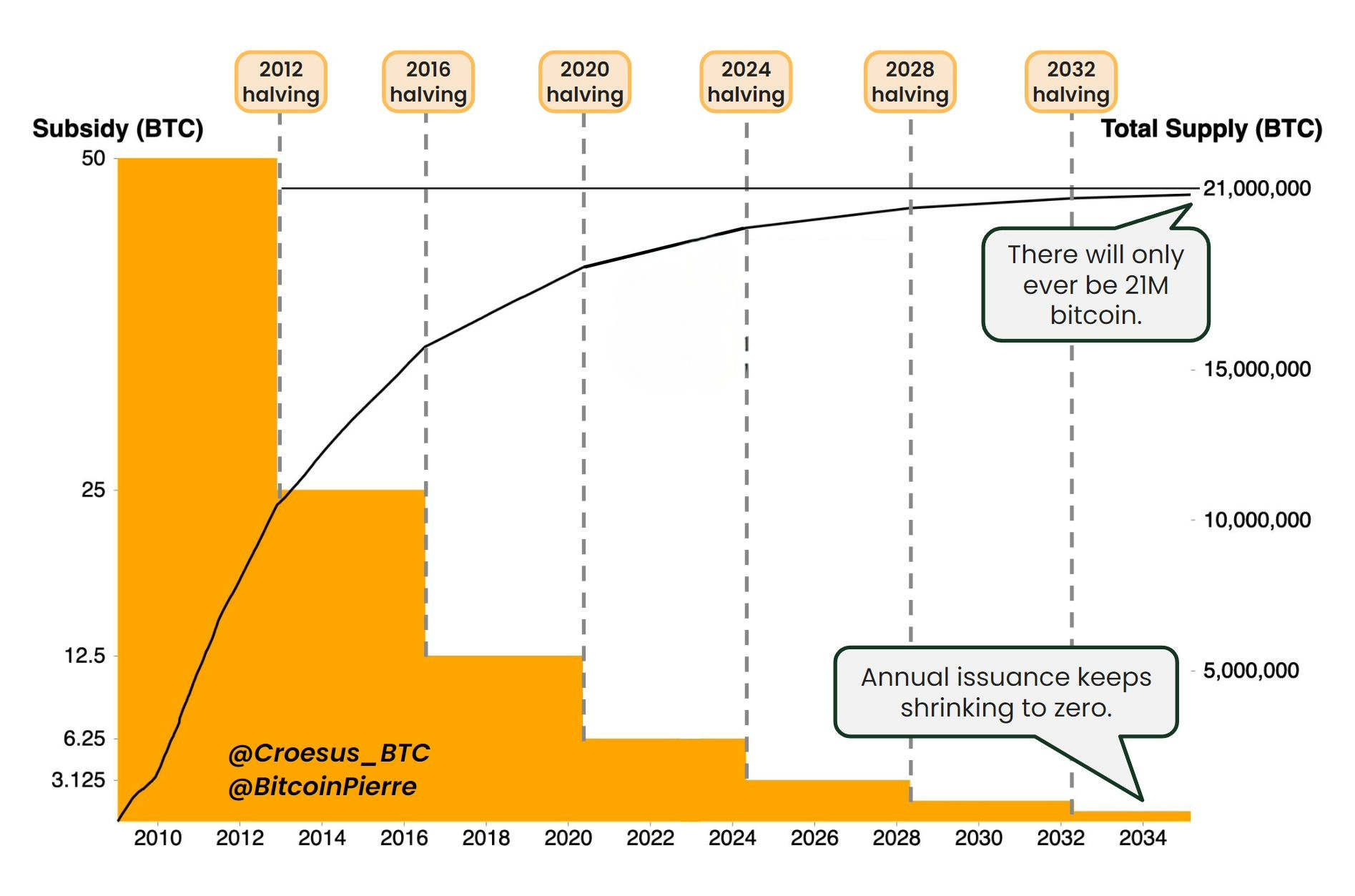
What most people miss is the second half of the equation.
As the block subsidy shrinks toward zero, transaction fees are supposed to pick up the slack.
Satoshi mentioned this in the whitepaper:

But what if the fees never arrive?
Right now, the most celebrated scaling solution in Bitcoin (the Lightning Network) routes the bulk of transactions off-chain.
And every single fee paid on Lightning goes to Lightning node operators. Nothing goes to miners.
If Lightning wins, miners lose incentive.
And if miners lose incentive, then Bitcoin is more vulnerable to a 51% attack.
The Question You Should Be Asking
Most people who follow Bitcoin evaluate L2 solutions on speed, cost, and user experience.
Which is reasonable criteria, but they skip the one question that determines whether Bitcoin survives long-term as a secure payments network: where do the transaction fees go?
This matters because Bitcoin mining has a math problem that price appreciation alone cannot solve.
In 2009, miners earned 50 BTC per block. Today, that number is 3.125.
That’s a 94% decline in the block subsidy. It drops another ~16% per year (compounded), and it will keep falling until it reaches zero.
Price has offset this. Bitcoin is up roughly 15,000% over the last 10 years, which has more than compensated for the shrinking subsidy.
Another 15,000% from here puts Bitcoin at $10.5 million per coin.
At that price, Bitcoin’s total value (~ $200T) would possibly exceed all of the fiat money in the world ($150T).
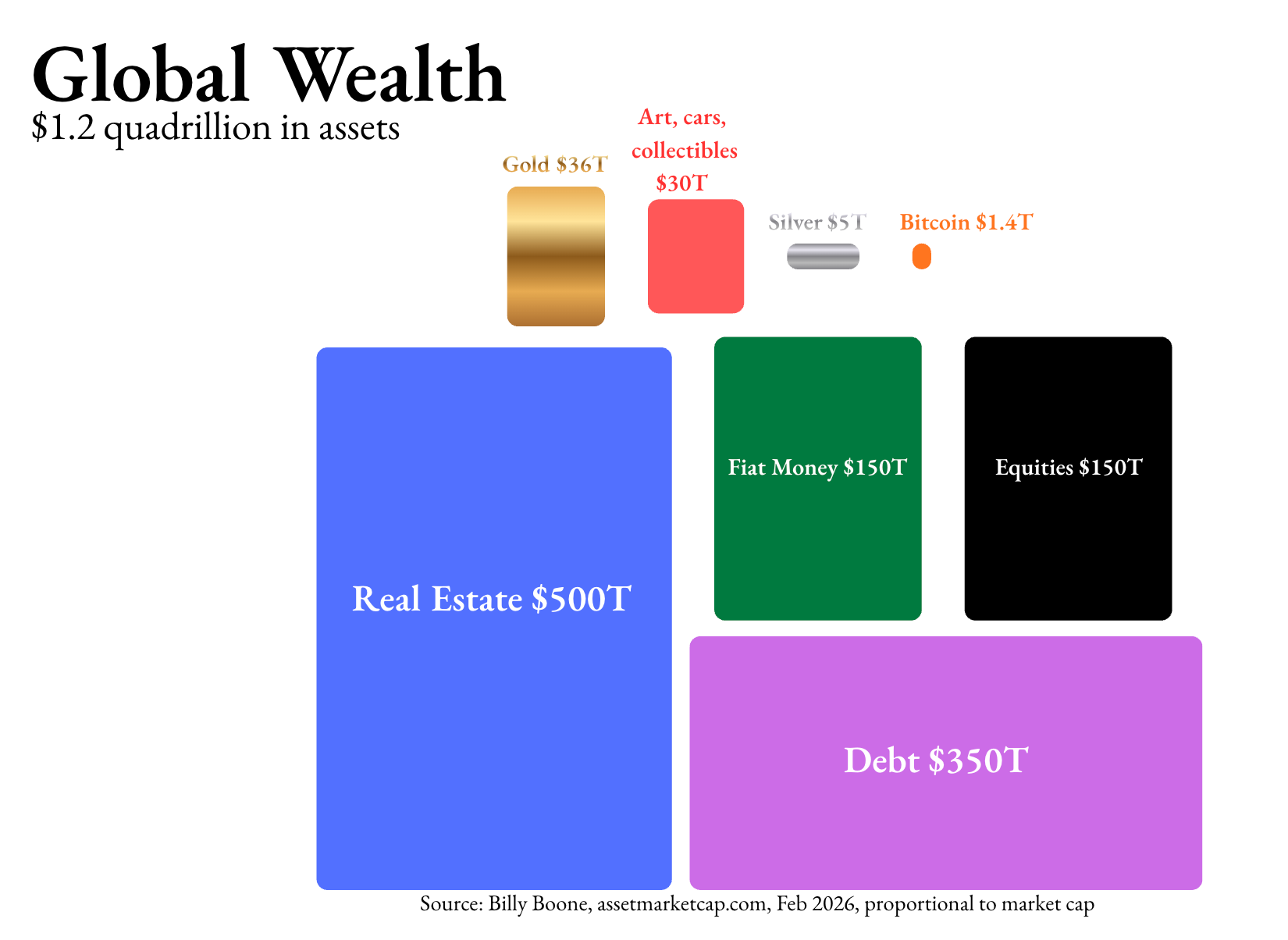
If that is the “ceiling” then miners can no longer rely on price appreciation 32 years from now to offset subsidy decline.
Even at $50 million per coin, by 2080 the block reward translates to roughly $9,536 per block. Which is maybe enough to buy a carton of eggs in 2080 dollars.
What does this mean?
Transaction fees aren’t a nice-to-have.
They are the entire long-term incentive model for the majority of Bitcoin security, or so it seems.
The Belief Most People Get Wrong
The popular view:
“Lightning Network scales Bitcoin. More Lightning adoption is always good for Bitcoin.”
What actually matters: Lightning (and similar non-mined L2s) route transactions off-chain and keep the fees for themselves.
Bitcoin miners only get fees when the channel is opened and closed.
The question is not whether L2s will dominate Bitcoin transactions. They will.
The question is: do those L2s feed the miners, or starve them?
The Bitcoin L2 Trilemma: Why This Is Hard to Fix

The second thing to understand is why building a “good” Bitcoin L2 is so difficult. There’s a trilemma here that most people haven’t seen articulated clearly.
Every Bitcoin L2 falls into one of three buckets, and each comes with a fundamental trade-off:
1. Off-Chain Networks (Lightning)
No blockchain, no public ledger. Data is stored by users. This gives you scalability and privacy, but limited smart contract functionality and a terrible user experience for anyone not running their own node. Lightning has received over $100 million in funding and years of elite developer hours. The results have disappointed many of its own creators. Only about 5,600 BTC sit on Lightning (0.025% of circulating supply). Multiple developers have publicly walked away or expressed serious frustration with the protocol’s fundamental limitations.
2. Decentralized Sidechains
These introduce a new token to fund their own security budget. The token lets anyone participate in consensus and creates an open marketplace of miners. The trade-off: a new token complicates the user experience, invites centralization, and deviates from the entire point of Bitcoin. But it also enables community building and capital raising for R&D, which matters in a space where most projects fail.
3. Federated Sidechains
No new token. Instead, a fixed group of trusted entities (like Liquid’s 15 crypto companies) run the consensus. Better user experience since you use a pegged version of BTC. But you’re trusting the federation, which limits decentralization. And without a token subsidizing security, the system depends on transaction fees that may be negligible for years until adoption picks up.
None of these are perfect. Each sacrifices something critical. The question is which sacrifice is most acceptable for the goal of keeping miners funded and the base layer secure.
The Solution (And What It Looks Like When It Goes Wrong)
The third thing to understand is what a potential solution looks like, and why execution matters more than the idea.
Merge mining is the most promising path for routing L2 fee revenue back to Bitcoin miners. The concept was invented by Satoshi in 2010. It lets miners find blocks on multiple networks simultaneously, so they can collect transaction fees from L2s without doing extra work. All L2 block value converts into L1 mining revenue.
Rootstock and Fractal Bitcoin demonstrated this is possible in practice, attracting as much as 94% of Bitcoin’s hashrate for merge mining. BIP 300 (drivechain) proposes a framework for merge-mined sidechains that could launch without changes to Bitcoin Core, using what’s called a CUSF (Core Untouched Soft Fork) activator.
The benefits over Lightning are significant: no channels, no interactivity requirements, no liquidity problems, no payment failures, direct L2 onboarding without using L1 bytes, and 100% of fees flowing to miners instead of 0%.
But merge mining is not magic. And we have a recent example of what happens when it goes wrong.
Fractal Bitcoin launched claiming to use Bitcoin Core code with 30-second blocks. It attracted roughly 40 EH/s from Bitcoin when three major mining pools (AntPool, F2Pool, SpiderPool) jumped in for the rewards.
In practice, it was a mess:
Fractal’s “Cadence Mining” system only merge-mines 1 out of every 3 blocks with Bitcoin. The other 2 are mined solely on Fractal. This defeats the purpose as it tries to pull miners away from Bitcoin rather than letting them mine both simultaneously.
The chain’s data is growing at an unsustainable rate, which is growing at 2TB/year (20x faster than Bitcoin L1). Running a full node becomes prohibitively difficult, which is a centralization problem.
Despite claiming to ease Bitcoin congestion, Fractal launched a 50% premined token ($FB) that has only gone down:

Not a good look.
Fractal is what happens when merge mining is used as marketing language rather than a genuine alignment mechanism.
The token, the cadence mining design, the unsustainable chain growth: all point to a project optimizing for short-term miner incentives rather than long-term Bitcoin success.
This is why the trilemma matters. You can’t just slap “merge mining” on a project and call it solved. The bridge design, the token structure (or lack thereof), the consensus model, and the node accessibility all have to work together.
What to Watch For
The soft fork process in Bitcoin is gridlocked. No new soft fork has activated since Taproot in 2021. BIP 300 needs 51%+ of hashrate for adoption.
The entities with the most at stake are ASIC manufacturers: Bitmain, MicroBT, and Canaan.
In a future where transaction fees are the bulk of mining revenue, every new ASIC they sell is only worth the fee revenue it expects to earn.
If the fee pie stays small because non-mined L2s captured the volume, they sell fewer machines and revenue declines.
Important signals to keep an eye on:
Any major ASIC manufacturer publicly supporting merge mining or BIP 300
Mining pools integrating CUSF activator software
New L2 projects launching with 100% fee passthrough to miners (vs. launching tokens)
Lightning Network capacity continuing to decline in absolute BTC terms
BitVM progress on trust-minimized bridges for federated sidechains (this could change the trilemma dynamics)
The Bitcoin L2 landscape is still early and most of these projects will fail.
But the structural question of who gets the fees is not going away. It will only become more urgent the closer we get to 2032
AI as Bitcoin’s Code Auditor
There’s one more angle here that almost nobody is discussing. And it might be the thing that breaks the gridlock.
Bitcoin’s soft fork problem is not purely political. It’s also a trust and review bottleneck. Bitcoin Core has a tiny pool of qualified reviewers. Every proposed change needs exhaustive security auditing before anyone will consider running it. And the CUSF approach (running a separate activator alongside Bitcoin Core) introduces new code that miners would stake their operations on. Who audits that code? Who verifies it won’t introduce vulnerabilities?
This is where AI enters the picture. And not in the vague “AI will change everything” sense. In a very specific, already-happening sense.
Anthropic just launched Claude Code Security, a tool that scans codebases for security vulnerabilities and suggests patches for human review. During testing, Claude Opus 4.6 found over 500 previously unknown high-severity vulnerabilities across production open-source codebases. These were bugs that survived decades of expert human review and millions of CPU-hours of automated testing. Claude found them by reasoning about code the way a security researcher does.
Think about what this means for Bitcoin specifically.
The CUSF activator for BIP 300 is written in Rust. It’s open source. It’s the kind of codebase that an AI security tool could audit rigorously before a single miner runs it. Same for any merge-mined sidechain code. Same for the bridge implementations that connect L2s to L1. These are all critical pieces of infrastructure where a single vulnerability could break Bitcoin.
Most Bitcoin L2 projects are built by small teams without dedicated security budgets. Lightning’s own history proves this: bugs that crashed nodes, routing vulnerabilities, liquidity exploits. A tool that can scan an entire codebase, find the subtle flaws, and suggest patches (with human approval required before anything ships) would be transformative for the pace of successful L2 development.
This doesn’t replace human judgment. The Bitcoin Core developers, the L2 builders, the miners, they all still make the final call. But it dramatically lowers the risk of deploying new code. And that lower risk is exactly what’s needed to accelerate shipping upgrades.
Bitcoin’s conservatism is a feature, not a bug. The network should be slow to change. But “slow” and “frozen” are different things. Right now, Bitcoin is frozen because the cost of getting new code wrong is existential, and the review capacity is too small. AI security tooling expands that capacity without lowering the bar.
Attackers will use AI to find exploitable weaknesses in Bitcoin infrastructure, which means defenders need to get there first.
If you own Bitcoin, you’re betting it stays secure for decades. That bet depends on miners having a reason to keep mining, L2s being built that actually pay them, and the code underneath all of it being bulletproof.
The security of your Bitcoin isn’t guaranteed by code alone. It’s guaranteed by those paid to enforce it.
- Billy