

Bitcoin miners spent $75,500 in cash to mine a coin worth $58,400 last quarter.
The same week that number came out, the most-read economist in Bitcoin published a piece saying Bitcoin’s electricity use has peaked for good.

The exodus everyone is calling the end of mining is the setup for the best mining window since 2020.
TLDR
Two pieces landed this week arguing mining is in structural decline: CoinShares’ Q2 report (public miners lost money on every coin, 35 EH/s leaving for AI) and Saifedean Ammous’ “Bitcoin Electricity Consumption May Have Peaked.”
The numbers in both are right. Hashprice hit an all-time low of $27.70 in June. Difficulty has gone 305 days without a new high.
The conclusion is wrong because it measures mining against the block subsidy. Mining’s real ceiling is unmonetized energy, and that number is more than 10x today’s network.
When high-cost capital leaves, difficulty falls and margin returns to everyone still plugged in. American Bitcoin mined at $43,851 while the cohort averaged $75,500.
I was wrong on 2026 price. The difficulty call broke in the direction that helps miners. Scenarios and a checklist for 2027 below.
Who is saying mining peaked, and why
CoinShares is a digital asset manager that publishes the most-cited quarterly report on public Bitcoin miners. Its Q2 numbers: aggregate cash cost of $75,500 per coin against a $58,400 quarter-end price.
Core Scientific paid $41.9 million to cancel 15 EH/s of hardware it no longer wanted.
Riot signed a 191 MW, 20-year AI lease worth about $9.1 billion.
CleanSpark signed a 20-year HPC deal worth $6.6 billion.
At least 35 EH/s is scheduled to leave the listed cohort.
Saifedean Ammous wrote The Bitcoin Standard, the book that brought most institutional money into Bitcoin.
His new piece argues mining can only grow while Bitcoin’s price more than doubles every four years, because the subsidy halves every four years.
His epoch table is correct and worth memorizing.
Average price by epoch: $5, $342, $5,758, $32,882, $84,099.
Each epoch’s subsidy revenue as a multiple of the one before: 31.6x, 8.4x, 2.9x, and now 1.3x.
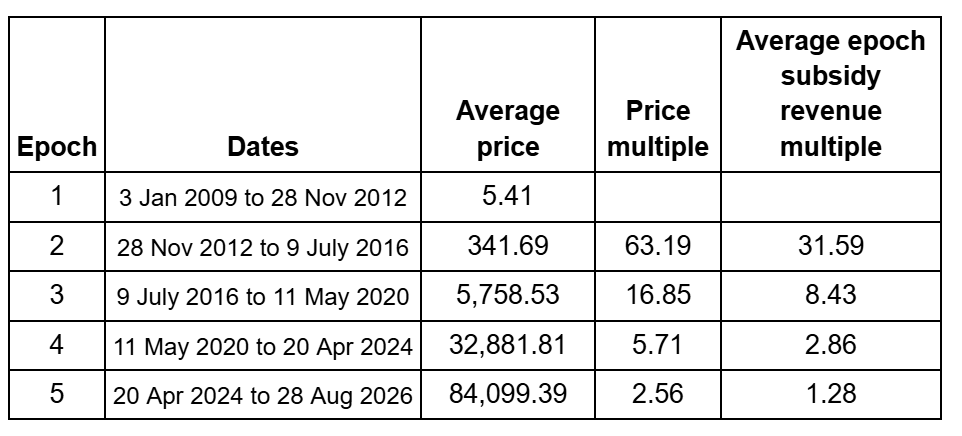
Adjust for dollar devaluation above 7% and this epoch’s real growth is roughly zero.
(keep in mind this epoch still has ~ 20 months before it's over and he is running these numbers at a cycle bottom)
Difficulty has gone 305 days without a new high, -18% off the ATH
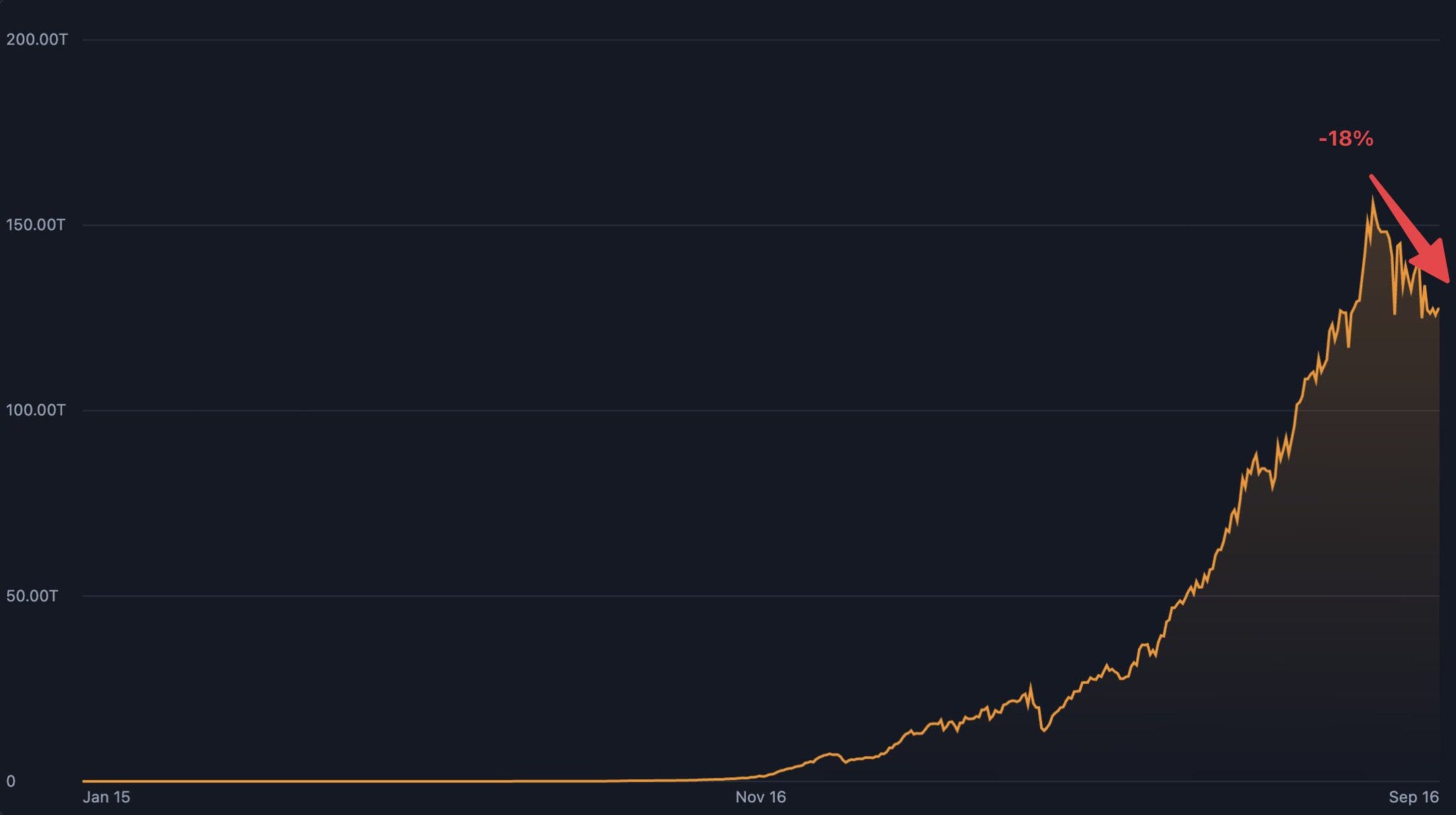
Bitcoin currently draws an estimated 18.2 GW today, consumed 160 TWh in 2025, about 0.5% of global electricity.
He says that is the top.
I agree with nearly every number in both documents, but there is a problem
The framing error
Saifedean models the sector. A miner does not live in the sector.
A miner lives on hashprice: dollars per petahash per day, set by Bitcoin’s price, network difficulty, the subsidy, and fees.
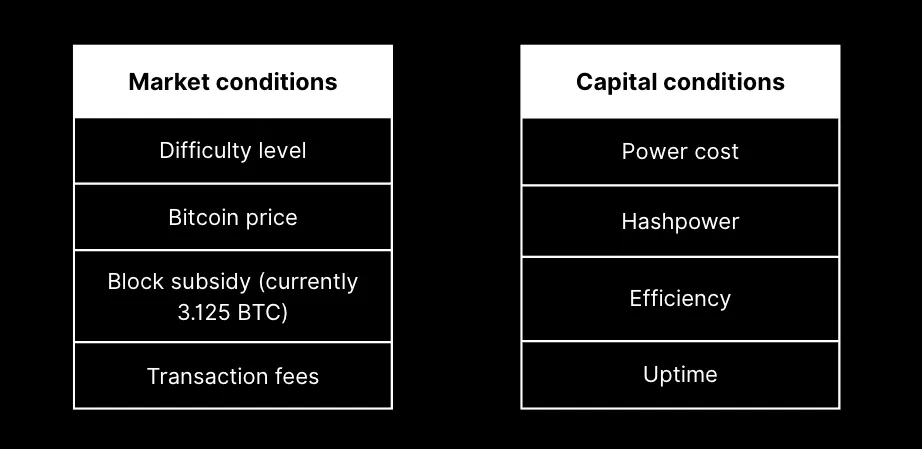
The subsidy hurdle describes when capital stops flowing into mining in aggregate.
Which is true.
But difficulty is a thermostat. When capital leaves, difficulty falls, and revenue per unit of hashrate rises for everyone still running.
The contraction he describes is the mechanism that restores margin to survivors.
His model treats it as a one-way exit, and in 16 years it has never once behaved that way.
CoinShares proves the point without meaning to.
American Bitcoin mined at $43,851 per coin in the same quarter the cohort averaged $75,500.
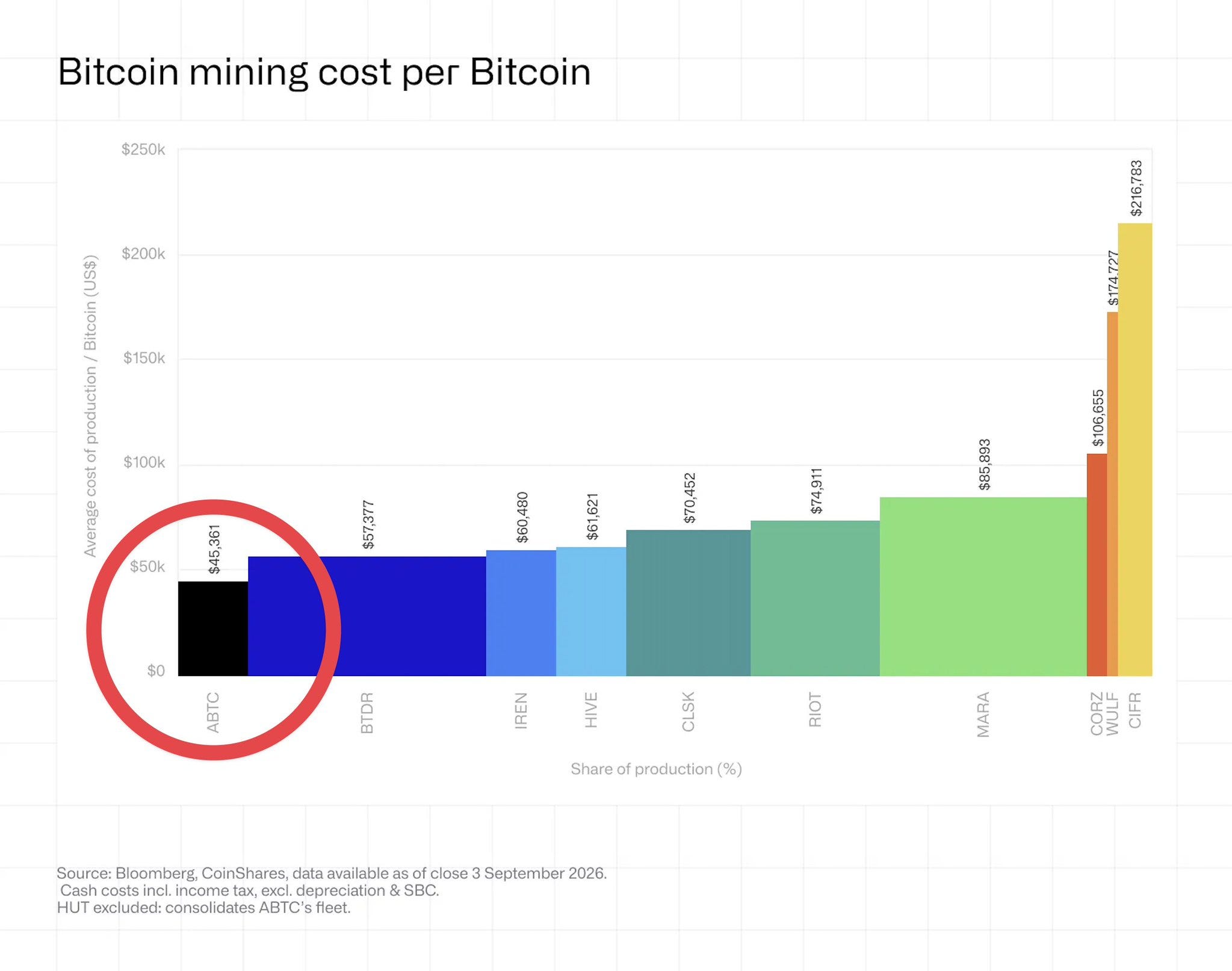
At a $58,400 price, the expensive half of the industry went unprofitable and the cheap half kept mining.
Show me the operating business and I will show you who survives.
The denominator
Here is the measurement error at the center of the peak claim.
Saifedean measures mining against subsidy dollars.
The right denominator is energy nobody else can buy.
In 2024, 65.8% of energy generated in the US was rejected, meaning it could not be used or sold. Much of that is waste heat that can never become electricity, so miners cannot capture all of it.
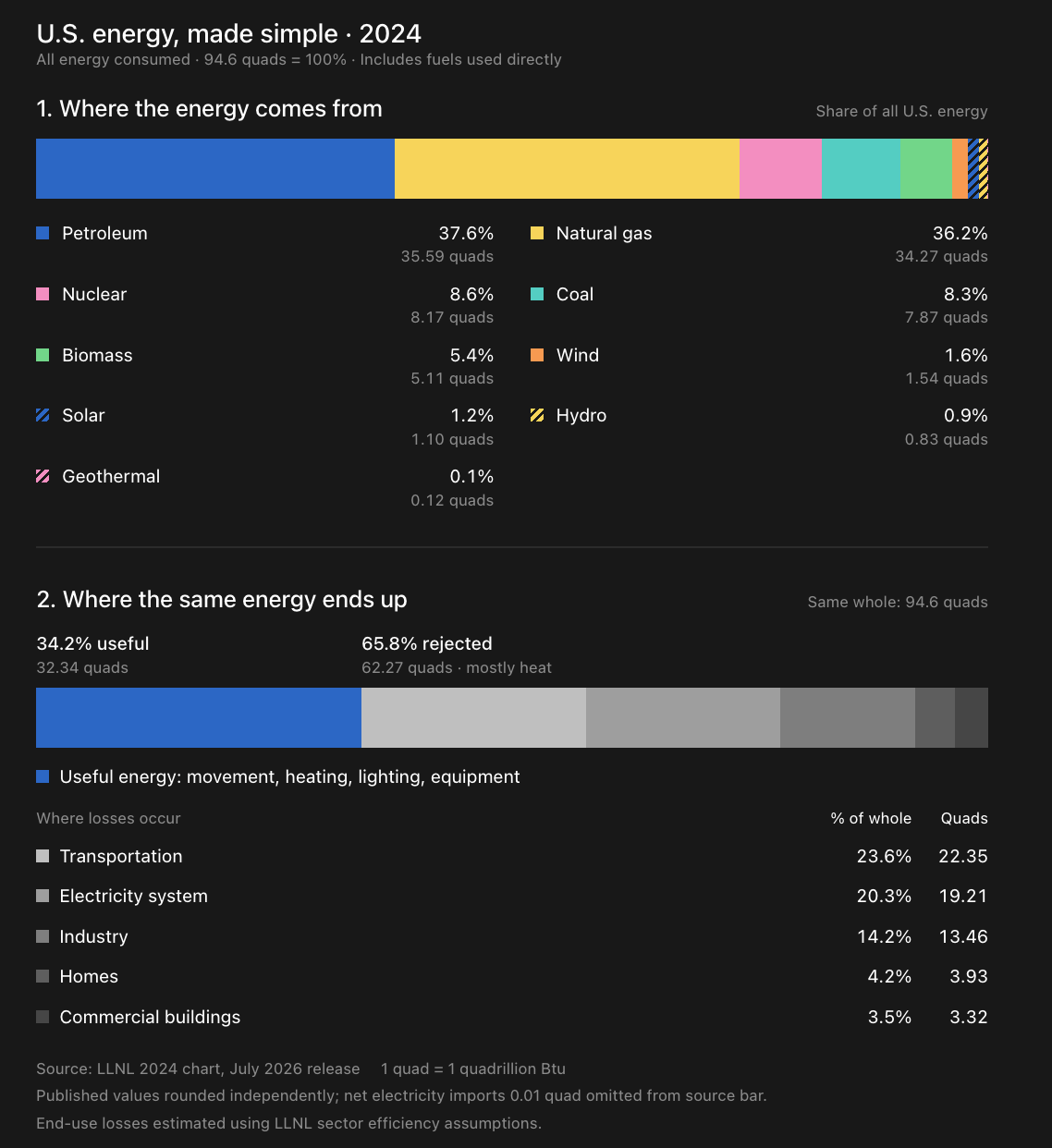
But the technically recoverable slice (curtailed generation, flare gas, recoverable waste heat) works out to about 970 TWh per year.
970 TWh supports roughly 10.1 ZH/s at 10 J/TH. More than 10x today’s network.
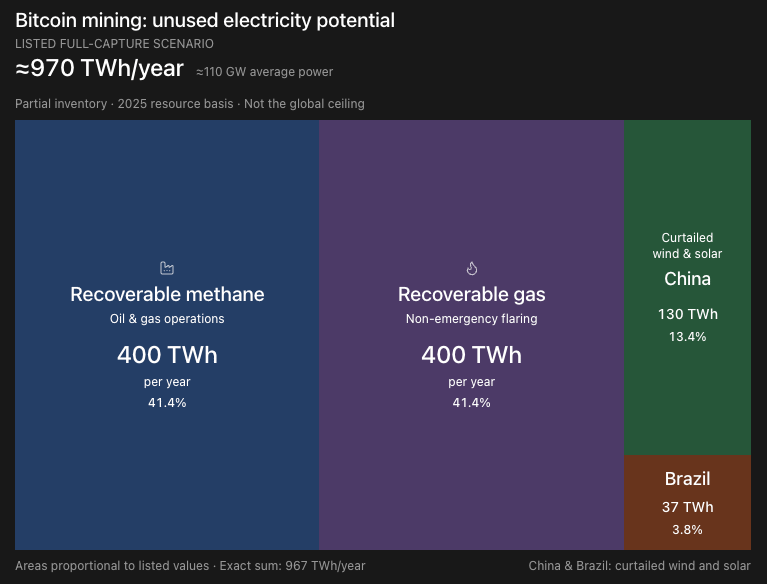
Bitcoin mining is the only industrial buyer that runs intermittently, at the edge of the grid, at a flare stack, behind a curtailed wind farm, with no latency requirement and no uptime guarantee.
That ceiling grows with every gigawatt of intermittent generation built, and it has nothing to do with whether Bitcoin doubles per epoch.
At near-zero power cost you can mine profitably forever.
AI does not compete for that energy.
AI wants tier-3 sites with fiber, redundancy, and 99.99% uptime, and it will pay 10x more per megawatt to get them.
CoinShares counted 225 data center moratoriums across 30 states fighting over exactly those sites.
So the public miners are selling premium infrastructure to the buyer who values it most.
Rational, and it leaves mining with the energy AI cannot use, which is the energy mining was built for.
Saifedean says this himself in one sentence (”if you have cheap electricity, pivot to AI data centers”) and then argues past it.
Correct for the top of the grid.
Irrelevant to the intermittent pockets, where the industry is moving.
Why difficulty growth was always going to slow
ASICs have improved roughly 1,000x since 2013, from thousands of joules per terahash to hydro machines near 10 J/TH.

The jump from 110 nanometer chips to 55 was easy. The jump from 5 to 3 is not.
Each generation now buys a smaller efficiency gain at a higher price, so each epoch adds less hashrate per dollar.
Difficulty growth had to diminish on physics alone (until there is a quantum tunneling breakthrough)

That is a maturing industry, and mature industries reward cost position over growth.
It also means a sub-15 J/TH machine bought today will not be obsolete in 18 months the way an S9 was.
On fees: S
aifedean excludes them and concedes rising fees “may invalidate” his analysis.
I think institutional settlement eventually makes blockspace expensive:


I also know fees have run about 2% of miner revenue for most of Bitcoin’s history.
I think over the next 15 years, that will go to 15%, but the overall thesis does not need it.
What I got wrong
In January I published a mine-versus-buy piece with a quantile model putting Bitcoin between $164,000 and $205,000 this year (which I suppose could still happen)

Bitcoin drew down 54% from its October high instead.
I wrote that difficulty would grow 30 to 40% in 2026.
It has fallen 18% from its ATH
I listed “price stays flat or drops” as the scenario that breaks the thesis (exactly what happened)
Price call wrong.
Difficulty call wrong in the direction that helps miners.
And the mechanism I described, AI competing for power and slowing hashrate growth, arrived faster and harder than I modeled.
The 2027 setup
Every great mining window has the same shape: price growth outrunning difficulty growth. 2019, 2020 to 2022, 2023 to 2024.
Hashprice is the spread between the two lines.
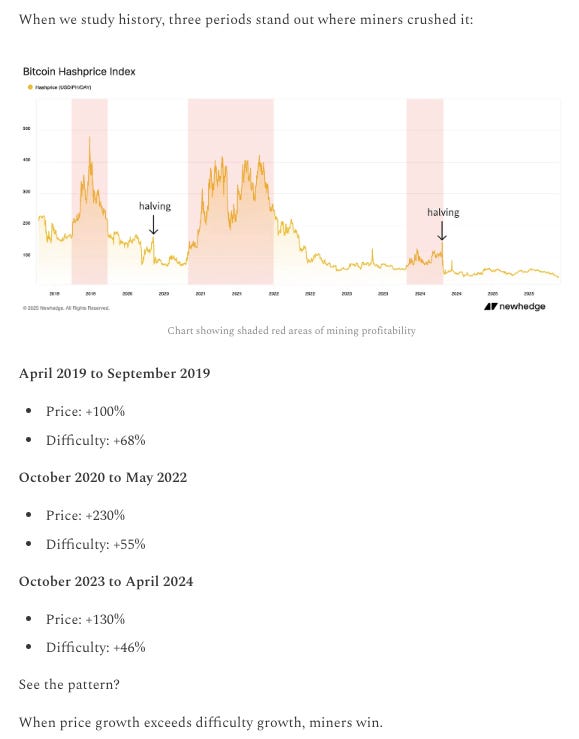
Difficulty: 35 EH/s scheduled to exit, the largest fleets locked into AI leases they paid to enter, Bitmain sitting on air-cooled inventory nobody wants, rig prices softening because the buyers of last resort just stopped buying.
Price: recovered from $58,000 to $75,000, with the 10-year above 5% and debasement back on the table. If the four-year cycle does what is always does, the trough window closes in Q4.

Run the scenarios at today’s ~920 EH/s:
Bear: Bitcoin back to $58,000, hashprice near $28. Only fleets under $45,000 per coin are profitable.
Base: Bitcoin $75,000 to $85,000, difficulty flat to plus 10%. Hashprice $36 to $42. Low-cost operators profitable, mid-cost at breakeven, machines cheap.
Bull: Bitcoin above $110,000 into 2027 while difficulty stays flat because the exits are locked. Hashprice above $55, the first expansion since July 2025, into a market where the competition paid to leave.
One line flat, the other rising, machines cheaper than they have been in years, and the highest-cost competitors paying to exit.
That divergence is forming at the exact moment the smartest voices in Bitcoin are calling a peak.
What to do with this
Your all-in cost per coin must sit below $50,000. That is the number that survived Q2. Power under $0.08 per kWh on a sub-15 J/TH machine gets you there.
The S23 Hydro miner hosted at Simple Mining at $0.07/kWh extrapolated cost basis is ~ $32k
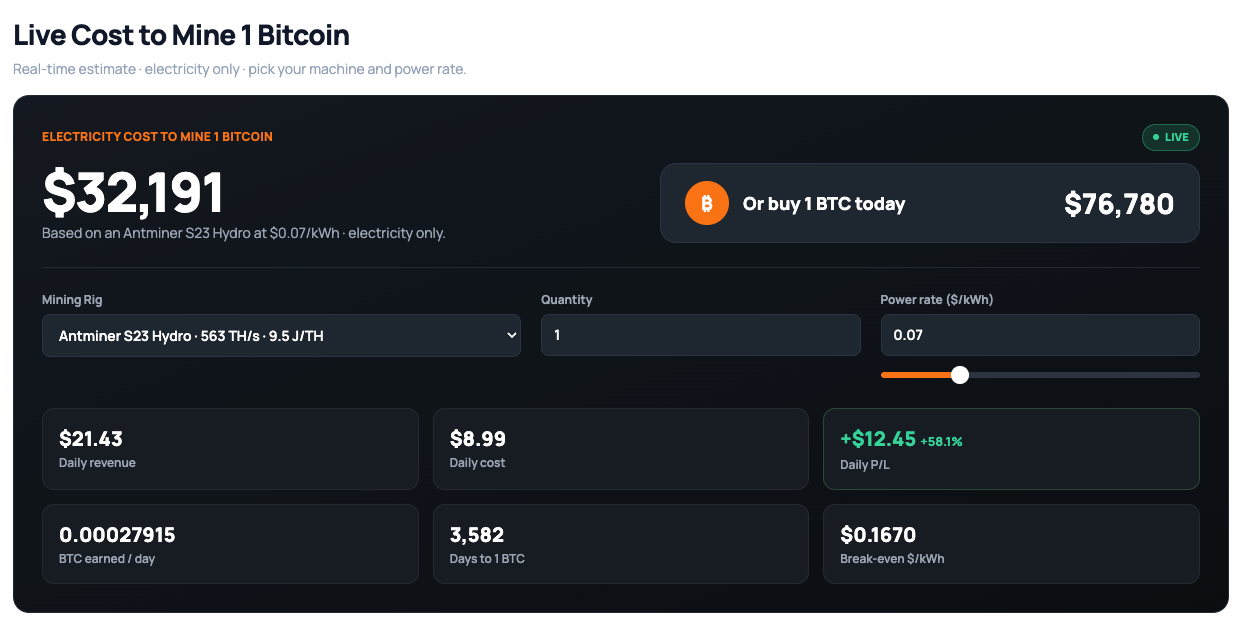
Watch the spread, not the price. Track 90-day price growth against 90-day difficulty growth. When price leads, the window is open.
Buy machines into the softening, not after. Rig prices follow hashprice with a lag. The moment hashprice breaks $45, the inventory clears.
Use the “mining advantage”. Curtailment programs, flare gas, behind-the-meter wind. Those keep mining through the next epoch regardless of who pivots.
(Simple Mining sites are based in Iowa running on 65% wind powered grid, participating in demand response)
Saifedean’s advice is to buy Bitcoin and let the miners pivot.
For most people that is right.
For anyone plugged in at low power cost, his conclusion is the setup.
The capital leaving is the margin arriving.
Full disclosure:
I am building Simple Mining, a hosting company, so I am talking my book.
If you want the case for producing Bitcoin instead of only buying it, the 7 reasons are in one place: simplemining.io/billy
Should be another interesting week in markets.
Where the energy flows, the money follows.
- Billy